The Constellation Is Not the Star Pattern
Learn the difference between a constellation and its star pattern, so you can read sky charts, follow stories and name the right part of the sky.
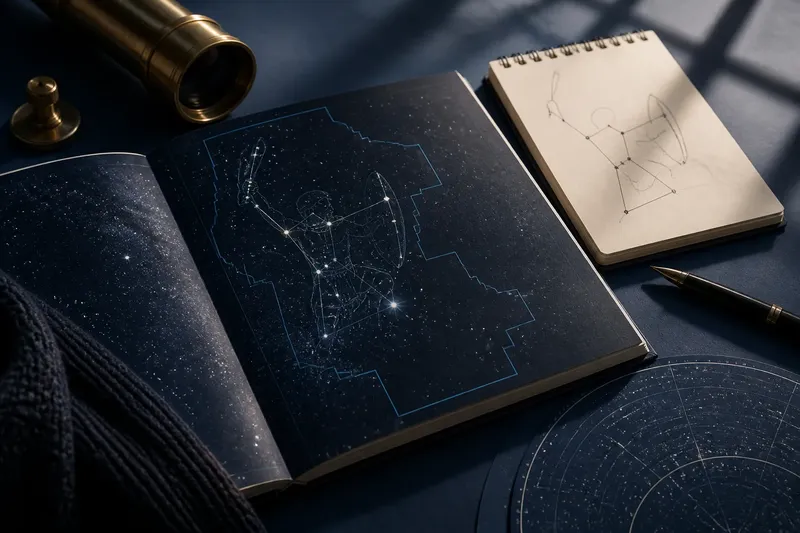
You trace the familiar hunter across a winter sky, then open a star chart and see a boundary enclosing far more than the handful of bright points. That mismatch is easy to explain: a constellation is not the same thing as the pattern people draw among its stars. Knowing which meaning fits your situation makes sky charts, conversations and stories easier to follow.
What does “constellation” mean on a sky chart?
On an astronomical chart, a constellation is a named region of the sky. The whole celestial sphere is divided into such regions, each with a defined boundary. A star belongs to the region containing its position, whether or not anyone includes it in a familiar drawing.
Orion, for instance, names both a constellation region and a well-known arrangement of bright stars. The region covers many more stars and other celestial objects than the outline often shown in a beginner’s guide. The outline is a way of recognising a shape; it is not the border of the constellation.
This distinction matters when you read an atlas, catalogue or observing app. A label such as “in Orion” identifies a patch of sky, not necessarily a point inside the hunter’s drawn body. The named region provides a consistent address, while the connecting lines provide a visual cue.
When should you think of the connecting star pattern?
If you are learning the sky by looking up, the familiar pattern is usually the useful meaning. A few bright stars can help you recognise a constellation and locate nearby sights. These patterns are often called asterisms: recognisable arrangements of stars that may sit within one constellation or cross several.
The Big Dipper is a good example. It is a prominent star pattern within Ursa Major, not the whole constellation. You can use its shape to orient yourself, while a chart’s Ursa Major boundary encompasses a much larger region.
Patterns also vary across sky guides and cultures. One guide may connect a different set of stars, or leave the lines out altogether. The stars themselves do not change because a diagram changes; the lines are a human aid for seeing and remembering a shape.
Which meaning fits your situation?
Choose the meaning according to the job you are doing. If you need a location, use the named region. If you need a visual landmark, use the star pattern. If you are interpreting a story or a cultural description, check how the speaker is using the word rather than assuming every use refers to a chart boundary.
- You are finding an object on a chart: Treat the constellation as a region. Follow the chart’s boundaries or coordinates, not just the lines between its brightest stars.
- You are learning the night sky: Start with the pattern shown in your guide. Use its bright stars as stepping stones, then notice that the surrounding region extends beyond the drawing.
- You are discussing an asterism: Name the pattern when that is what you mean. Saying “the Big Dipper in Ursa Major” distinguishes the familiar shape from its larger constellation.
- You are reading a catalogue entry: Read the constellation name as a location label. An object can lie within the region without touching the stars used to draw its outline.
- You are comparing sky traditions: Separate the chart’s standard region from a culture’s star pattern or story. They can refer to overlapping stars while organising them differently.
Say you are looking for a faint object listed in Cygnus. The chart places it well away from the cross-shaped pattern often used to recognise the Swan. You would search within the Cygnus region, using the chart’s position markers; tracing only the cross would not identify the object’s address.
Why do the drawings and boundaries fail to match?
A drawing is selective by design. It connects a small set of stars that makes a memorable outline, while a boundary must account for the full sky area assigned to a constellation. The two serve different purposes, so expecting them to coincide creates the confusion.
Star patterns are also interpretations, not lines physically present in space. The stars that appear next to one another in the sky can be at very different distances from Earth. Connecting them on paper helps the eye, but it does not assert that they form a single nearby group.
There is no need to memorise every boundary before enjoying the sky. What is not worth the effort is trying to infer a constellation’s exact edges from the shape of its printed lines. When precision matters, use a chart that displays region boundaries or a labelled sky atlas.
What should you call a constellation in different contexts?
Does a constellation mean a group of physically related stars?
Usually, the word names a sky region or, in casual speech, its recognisable star pattern. The stars that make up a pattern may be separated by great distances and need not form a physical group.
Is an asterism the same as a constellation?
No. An asterism is a recognised star pattern, while a constellation in modern charting is a defined region. An asterism can be part of one constellation, as the Big Dipper is within Ursa Major.
Can the same stars belong to different patterns?
Yes. People can connect or interpret stars in more than one way, and traditions may tell different stories about the same patch of sky. The region name on a standard chart remains a separate kind of label from those patterns.
How can I tell which meaning a guide intends?
Look at the context: boundary lines, coordinates and object listings point to the region, while connected dots and outline drawings point to a pattern. If the guide uses “constellation” loosely, its diagram or surrounding explanation usually makes the intended sense clear.
How does the distinction help with sky traditions?
It lets you discuss stories without treating one drawing as the only correct way to see the stars. A constellation boundary is a practical standard for locating things; a star pattern is a cultural and visual way of making a shape legible. Both can be useful, but they answer different questions.
When someone describes a figure in the sky, ask whether they mean a named chart region, a recognisable arrangement, or a story attached to those stars. That small distinction keeps the conversation clear while leaving room for more than one way of looking up. For the next sky chart you open, remember: the constellation is the address; the star pattern is one way to recognise the neighbourhood.