Planetary Romance or Hard Science Fiction? How Setting Shapes the Story
Planetary romance or hard science fiction? See how each tradition uses landscape, plausibility and limits to build an imagined world that feels distinct.
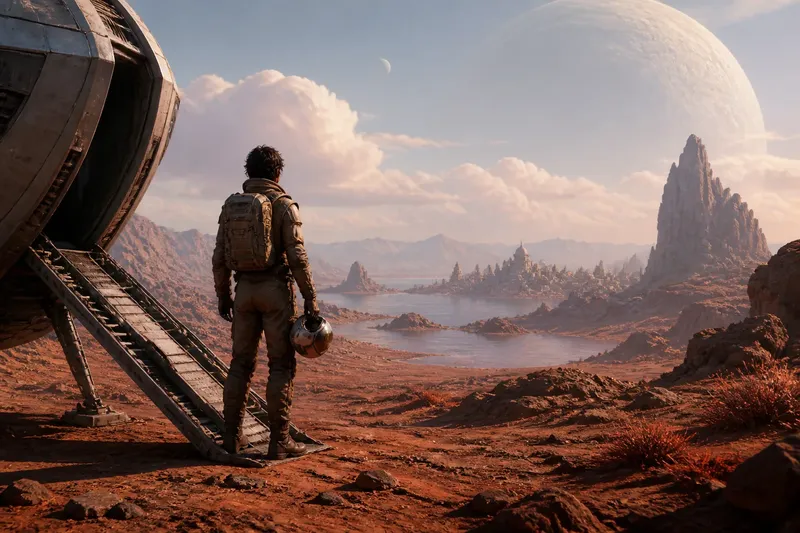
A traveller steps off a ship onto a red plain. In one story, the horizon promises lost cities, strange customs and a contest for a kingdom; in another, the thin air and unreliable equipment dictate every move. That difference is the heart of planetary romance or hard science fiction: both send us into imagined worlds, but they ask the setting to do different work.
These traditions are not sealed boxes. A story can borrow from both, and neither label tells you whether a book is thoughtful, exciting or convincing. The distinction is more useful as a way to notice what a world makes possible, what it makes difficult, and what kind of attention it asks from its characters.
1. What does the landscape promise?
Planetary romance treats a world as a stage for encounter and transformation. Its terrain may be vivid, perilous and unfamiliar: a salt desert crossed by caravans, a jungle threaded with ruins, or a chain of islands ruled by rival communities. The landscape invites the reader to wonder what lies beyond the next ridge.
In this tradition, setting often gathers several functions at once. A mountain pass can separate political powers, test a hero’s nerve and conceal a route to an ancient city. The world feels large because it contains places with distinct identities and stories, not simply because its map extends far beyond the page.
Hard science fiction more often asks how a landscape behaves. A planet’s gravity, atmosphere, temperature, geology and orbit can shape the action. The details need not dominate every scene, but they influence what people can do and what resources they need. A plain might matter because dust interferes with machinery or because a crew has to protect its water supply.
The difference is not “beautiful scenery” versus “technical scenery”. A scientifically grounded setting can be evocative, while a romance world can have careful internal logic. The question is whether the landscape mainly opens a field for adventure or presses practical conditions upon the people living in it.
2. What makes the world feel plausible?
Planetary romance often establishes plausibility through imaginative coherence. Its invented customs, creatures and political arrangements should feel as if they belong to the same place. Readers may accept a hidden civilisation or an extraordinary beast if the story gives it a convincing role in local life and sustains the tone it has established.
Hard science fiction tends to make plausibility depend more visibly on causal links. If travel is slow, distance affects communication and decision-making. If a habitat depends on machinery, maintenance can become part of daily life. A story need not pause for a lecture, but its imagined technology and environment should behave consistently enough for readers to follow the consequences.
Neither mode is a contest to see which has more facts. A page crowded with technical vocabulary can still leave a world feeling arbitrary; a fantastical setting can feel persuasive when its rules are clear. Plausibility is a reading agreement: the story gives you expectations, then earns trust by honouring or deliberately challenging them.
Say a writer imagines a settlement beside a vast inland sea. In a planetary romance, the sea might carry rival fleets, sacred islands and a rumour about a vanished capital; the expected result is a setting that draws characters into discovery and conflict. In hard science fiction, the writer might make the settlement’s location depend on a carefully considered supply route and environmental conditions; the expected result is that geography shapes everyday choices and the limits of survival. Either approach can make the same coastline memorable, for different reasons.
3. How do limits shape the adventure?
In planetary romance, danger can come from opposition, mystery or the sheer scale of the unknown. A character may cross a wilderness, negotiate with an unfamiliar society or uncover a threat embedded in the world’s history. The setting creates obstacles, but it may also offer unexpected allies, paths and possibilities.
Hard science fiction often makes constraints more continuous. Energy, air, food, radiation shielding, distance or mechanical failure can narrow a character’s options. These pressures are not merely obstacles to clear before the “real” plot begins. They can determine the plot’s shape, forcing people to choose which risks to accept and which resources to preserve.
That emphasis changes the texture of suspense. In a romance, a dangerous pass may lead to a confrontation or discovery; in hard science fiction, the same passage might be tense because a vehicle cannot manage the terrain or because the crew has limited supplies. The reader’s question shifts from “What will they find?” to “What can they afford to do?”
It is not worth the effort to turn every detail into a calculation. A story can lose its pace if characters stop repeatedly to explain familiar machinery or recite environmental conditions. A few well-chosen limits, consistently applied, usually create a stronger sense of consequence than a catalogue of technical facts.
4. What should the reader pay attention to?
When you are deciding which tradition a story leans towards, watch how the setting enters the scenes. Does it mainly provoke curiosity, supply a route for adventure and give different communities a distinct atmosphere? Or do the world’s physical conditions shape routines, technologies and the choices characters can realistically make?
Notice, too, what the narrative treats as surprising. A hidden city or a local custom may be a major revelation in planetary romance. In hard science fiction, the revelation may concern a system’s failure, an unexpected environmental effect or the consequences of a technical decision. These are tendencies, not rules: a single book can move between them.
Finally, ask whether the story wants you to feel that the world is wondrous, demanding, or both. Wonder does not belong only to planetary romance, and rigour does not belong only to hard science fiction. The useful distinction lies in the relationship between a world’s possibilities and its constraints.
Which questions help distinguish the two traditions?
Can a planetary romance include scientific detail?
Yes. Scientific detail can enrich its landscape or explain how people travel and live there. The story leans towards planetary romance when exploration, encounter and the imaginative character of the world remain its main attractions.
Does hard science fiction need to explain every invention?
No. It needs enough consistency for important inventions and environmental conditions to have understandable consequences. Explanations can be brief, implied or woven into action rather than delivered as technical lectures.
Can one story be both planetary romance and hard science fiction?
It can combine them, especially if an adventurous journey unfolds under clearly established physical limits. The balance depends on whether the story gives more weight to discovery and atmosphere, or to the practical consequences of its world-building.
Is one tradition more realistic than the other?
They pursue different kinds of credibility. Hard science fiction foregrounds causal and material plausibility, while planetary romance often builds conviction through a coherent imaginative world and a sustained sense of wonder.
5. How does the setting change the meaning of the story?
A world is more than a backdrop because its design tells the reader what kinds of stories can happen there. A richly varied planet encourages encounters between places and cultures; a tightly constrained habitat draws attention to interdependence, planning and the cost of mistakes. The setting also shapes how characters understand themselves: as explorers, residents, outsiders, caretakers or survivors.
That is why the most satisfying comparisons look beyond surface features. A ruined city does not automatically make a story planetary romance, and a spacecraft does not automatically make it hard science fiction. Ask instead what the city or spacecraft does to the plot. Does it open a door into a larger, stranger world, or make the consequences of a specific condition impossible to ignore?
Planetary romance or hard science fiction, then, is less a choice between fantasy and fact than a choice about emphasis. One tradition often makes the world feel like an invitation to venture further; the other often makes it a system whose limits must be understood. The strongest imagined worlds can do both, but noticing which impulse leads helps explain why a story’s setting feels like a promise in one book and a pressure in another.
When you pick up your next space story, try following one recurring detail—a landscape, a travel method or a scarce resource—and see how it steers the characters. That small habit reveals not only what kind of world you have entered, but what the story believes its world is for.